Wednesday, February 15, 2006

We are officially behind...


Bravely taking on both books 2 and 3, Nicole gave us a thorough digest of them today, complete with a handout outline. (Thanks, Nicole!) A lot happens in these two books, so we will allow another day for our discussion, concluding it on Friday, Feb. 17.
Let's focus on the issue of censorship, true lies vs. lies in words (p. 54)

That means we are a day behind. Accordingly, Nick will present book 4 on 2/20, Joseph book 5 on 2/22, and so on.

Thursday, February 09, 2006

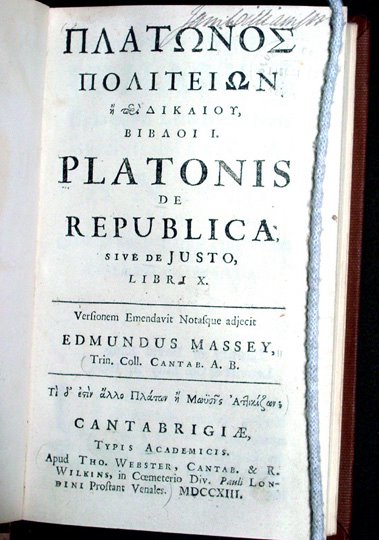
Plato's REPUBLIC Assignment


Each student has drawn, by lot, a chapter from the Republic. (See list below.)

Your assignment:

· Read the chapter thoroughly.
· Make a summary or outline of the main points, and be ready to share it with the class. If you’d like to pass out copies or other types of handouts, check with Dan Collins about getting them made. (Please give him at least two day’s notice.)
· Lead the class in discussion for at least 30 minutes.
· For your Paper #2, turn in your summary/outline, proposed discussion questions and a two page evaluation of the discussion, making any clarifications or further observations that might be needed to round out our understanding of the chapter. Please include a bibliography of any works you have used in preparing for the discussion.
· This paper will be due exactly one week after you’ve led your discussion.

Tentative Discussion Schedule:

Book 1: pp. 1-30; Joshua 2/13
Book 2-3: pp. 40-83; Nicole 2/15
Book 4: pp. 84-115; Nick 2/17
Book 5: pp. 117-148; Joseph 2/20
Book 6: pp. 149-176; Brandon 2/22
Book 7: pp. 177-202; Aimee 2/24
Book 8: pp. 203-229; Dan 2/27
Book 9: pp. 230-251; Abby 3/1
Book 10: pp. 251-277: James 3/3

Assignment for Friday, Feb. 10


1) If you haven't already begun, start reading the Republic. Josh will be leading us on Monday in a discussion of Book I.

2) Friday we will finish up Symposium, paying particular attention to Alcibiades as he contrasts with Socrates. Who loves best? Who loves more? Alcibiades or Socrates?

3) If we have time, I will mak some introductory remarks about the Republic, and we can chat about the video.

Wednesday, February 08, 2006

Philosophical Gourmet Report


So you want to go on to grad school and study philosophy?

Check out this site:
http://www.philosophicalgourmet.com/rankings.htm

It's Blackwell's Philosophical Gourmet Report, which ranks Anglo- American graduate programs using various criteria. Here's a slice:


What the Rankings Mean

The rankings are primarily measures of faculty quality and reputation. Faculty quality and reputation correlates quite well with job placement, but students are well-advised to make inquiries with individual departments for complete information on this score. (Keep in mind, of course, that recent job placement tells you more about past faculty quality, not current.) Due to the time-consuming nature of this Report, it is published only every other year.
The Update Service will continue to provide timely updates about important faculty moves.

The conventional demarcation of "analytic" versus "Continental" philosophy has become less and less meaningful. With the demise of analytic philosophy as a substantive research program since the 1960s (see Section II-B below), "analytic" simply demarcates a style of scholarship, writing and thinking: clarity, precision and argumentative rigor are paramount. Thus, "analytic" philosophy is now largely coextensional with good philosophy and scholarship, regardless of topic or figure. (Of course, there is still a good deal more formal work that goes on under the heading of "analytic" philosophy which has no analogue in other traditions.) It is no surprise, then, that the best work on so-called "Continental" figures is done largely by philosophers with so-called "analytic" training.

So, too, "Continental" is an increasingly meaningless label: much of what philosophers do on the European Continent these days is "analytic" philosophy or historical scholarship. While a small minority of philosophers in the U.S. still use the label "Continental philosophy" to demarcate whatever someone suitably obscure has done in Paris recently, the label is best-reserved as a characterization for a group of important historical figures largely in Germany and France in the 19th and 20th centuries; in that respect, the label is much like the labels "medieval philosophy" or "early modern." And as with these other historical groupings, there are some overlapping thematic affinities among the figures so designated, but there are also discontinuities and in some cases profound differences (e.g., Husserl has more in common with Frege than with Nietzsche, and Habermas more in common with Rawls than Marx).

The collapse of a useful analytic/Continental divide led several years ago to dropping the misleading "analytic" from the subtitle of the Report. There is one discipline, philosophy, which includes many topics and figures, and which admits of good and bad work. Certainly there remain differences in styles of philosophical work, but those differences are no longer illuminated by the analytic/Continental divide. This Report tries to capture existing professional sentiment about quality at different programs and in different fields in the English-speaking world. (Lack of reliable information leads me to exclude the non-English-speaking world, though there are thriving philosophical communities in, e.g., the Scandanavian countries, Israel, Germany, etc., but they are beyond the scope of this Report.) Obviously, there will be groups and departments on the margins of the profession-or which used to be at the top of the profession, and whose decline has been charted--who will resent such an evaluation effort, but qualitative assessment remains of great importance to prospective students.
Yet there remain some important differences in how departments approach philosophy. One important difference concerns the priority different departments give to the history of philosophy. You can get a good idea of which programs are most committed to history of philosophy by reviewing the Specialty Rankings, below. Some excellent departments--like Rutgers and MIT--are ranked in hardly any historical areas, while others--like Princeton, Pittsburgh, Berkeley, Oxford, Stanford, and UC Irvine-are ranked in multiple historical areas. Conversely, some programs give less priority to "contemporary," substantive areas (like philosophy of mind or metaphysics) in favor of a strong historical orientation: for example, Chicago, Penn, Boston University, and Emory.

Another significant divide in professional philosophy is marked by those philosophers who are naturalists and those who are not. The naturalists are skeptical that philosophers have any distinctive methods or techniques that allow them to solve problems without the assistance of empirical science; philosophy for the naturalists is just an abstract branch of empirical science, examining and clarifying empircal claims, but not adding any substantive body of knowledge to the task of philosophy. Naturalists differ in their commitment to this approach, but all share the idea of philosophy as a discipline which is simply continuous with empirical science. The non-naturalists, by contrast, do not view empirical science as a relevant constraint upon, or necessary element in, philosophical work. Philosophy remains an essentially a priori discipline, in which intuitions, thought experiments, and conceptual analyses do most of the work.

Some departments have significant naturalist contingents: for example, NYU, Rutgers, Michigan, Arizona, Cornell, UC Davis, CUNY, Maryland, Duke, Connecticut. Others have large non-naturalist (or even anti-naturalist) contingents, like Pittsburgh (Philosophy proper, not HPS), Harvard, Notre Dame, Berkeley, Chicago, Yale, Penn, Colorado, and Johns Hopkins. Most have some mix of the various positions, and even the departments just noted don't speak univocally. Most UK departments tend to be squarely in the non-naturalist camp, many Australasian departments in the naturalist camp..


Tuesday, February 07, 2006

How to Write Your Papers


I. Description: Your paper should be
A. 2-3 pages, typed

1. this means its going to be a modest essay, not a dissertation
2. this means it will be hard copy, not an attachment

B. on a question chosen from the handout, or one of your own, cleared with me

1. this means I want you to interact more fully with material we’ve been covering in class
2. this means your paper topic will be modest, narrowed down enough to fit the page constraints.

C. making a reasoned defense (argument) for some claim

1. this means your paper will present a thesis, defend it, and address possible criticism(s) of that thesis.
2. this means it will not be a pure research paper.
a. It won’t be the kind you might write for a history or science course, documenting the latest research, or the spectrum of scholarly opinion. You won’t be cutting and pasting lots of lengthy quotations.
b. however, you may need to do some research, and you may need to do some footnotes/endnotes.
3. on the other hand, this means it will not be a work of literature or rhetoric. That is, it won’t be about your feelings or impressions on a topic, nor will it use techniques of persuasion to get your reader to agree with you.b. however, your creativity and originality in the reasoned support of your own thesis, and the reasoned evaluation of other positions is welcomed. Furthermore, correct grammar and spelling will be expected.

II. Evaluation: Your paper will be graded on its
A. Clarity
1. Do you understand what you’re talking about?
2. Have you defined relevant concepts?
3. Have you given sound or cogent arguments in support of your thesis?
4. You must say explicitly what you mean; don’t assume your reader will know.
5. Don’t think that you have to report everything that’s ever been said about the topic. Narrow it down!

B. Conciseness

1. You don’t need to waste time writing a flowery introduction. Avoid “cuteness.”
2. Your paper’s first sentence should be its thesis.3. Edit, edit, edit. Anything that doesn’t directly further your thesis or the arguments relating to it has no business remaining in your paper.

C. Completeness

1. Have you addressed the strongest criticisms of your thesis? Have you anticipated criticisms of your thesis? (Don’t argue against straw men.)
2. Have you used examples and definitions to further your argument? Don’t be afraid to do so. If they’re relevant, they’re well worth the space they take up in your paper.

III. Resources

There are hundreds of books, pamphlets and websites that are available to help you write better philosophy papers. Here are a few of the ones I like:

A. Writing Philosophy Papers, by Colin Allen of Indiana University-Bloomington. Basic, no-nonsense site.http://mypage.iu.edu/~colallen/writing.html

B. Writing a Philosophy Paper, by Peter Horban at Simon Fraser University (Canada). This is my favorite site. Clear, concise and complete.http://www.sfu.ca/philosophy/writing.htm

C. Writing Philosophy Papers, by James Pryor of Princeton University. Extremely thorough, takes you by the hand step-by-step through the process.http://www.princeton.edu/~jimpryor/general/writing.html

D. Writing Philosophy Papers: A Student Guide, at the OSU Philosophy Department website. ( A 108 page manual, maybe more than you ever wanted to know)http://oregonstate.edu/Dept/philosophy/resources/resources/guidestuff/index.html

Sunday, January 29, 2006

Syllabus: Plato and Aristotle


Spring, 2006
Beth Bilynskyj, instructor

A 307
MWF 2-2:50pm

Description of Course:

• a seminar introducing and critically examining the thought of Plato and Aristotle. Particular attention will be given to Plato’s Republic and Aristotle’s Nichomachean Ethics.

Purpose of Course:

• To enable students to increase their ability to think rationally, critically and creatively.
• To provide a fundamental part of a Christian liberal arts education, integrating NCC’s biblical and Christian studies with rigorous philosophical study.
• To prepare students for effective and successful roles in teaching and the liberal arts.
• To encourage students to personally grow in virtue (arete) and the contemplation of what is good, true and beautiful.

Course Objectives:

Upon completing this course, you will be able to:

• Analyze and evaluate the claims of Plato and Aristotle by having written five critical essays
• Demonstrate proficiency with relevant concepts and claims by having participated in lively class discussion.
• Compare and contrast Plato and Aristotle’s metaphysics, epistemology, ethics and politics by having completed a final essay exam.
• Describe and use dialogue and dialectic as models for teaching
• Describe and discuss the teleological dimensions of life’s issues and practices.

Textbook and Resource material:

• Plato, Five Dialogues: Euthyphro, Apology, Crito, Meno and Phaedo, translated by G.M.A. Grube and revised by John M. Cooper. 2nd ed. Indianapolis: Hackett, 2002.

• Plato, The Republic, translated by Benjamin Jowett. Mineola, NY: Dover, 2000.

• Aristotle, The Nichomachean Ethics, translated by J.A.K. Thomson, revised with notes and appendices by Hugh Tredennick, introduction and Further Reading by Jonathan Barnes. Further Revised edition. New York: Penguin, 2004.

• Aristotle, Metaphysics selections, available online at
http://classics.mit.edu/Aristotle/metaphysics.html

• Aristotle, Physics selections, available online at
http://classics.mit.edu/Aristotle/physics.html

• Aristotle, On the Soul selections, available online at
http://classics.mit.edu/Aristotle/soul.html

• Handouts and reserve readings, at instructor’s discretion.


Instructor Information:

• Beth Bilynskyj, M.A. Philosophy, University of Notre Dame, 1979.

• 744-9343 (home phone; leave message and best time for me to return your call)

• bethb@valleycovenant.org (probably the best way for us to immediately connect)

• Office Hours: Fridays, 1-2pm; or by appointment

Please feel free to contact me. It is important that we end confusion and answer your questions as soon as possible. I also welcome your comments on the content of the course, and/or any suggestions you have to improve the class. Most of all, I want to get to know
you, and have you get to know Plato and Aristotle.

Grading:

1. Attendance, reading, participation (25%)

Philosophy has been described as a “great conversation,” so the focus of our time together will be discussing the day’s assigned readings. Plan to spend at least two hours in preparation for every hour in class. Those who have not read the material will be unable to contribute profitably to the discussion, so their participation scores will suffer. Absence is the greatest damper for discussion, so you should make every effort not to miss class. Everyone has something to contribute, so your presence is important. Please refer to the attendance policy below.

2. Critical Essays (5 worth 10% each)

Emphasizing clear exposition, critical thinking and evaluation, these essays give you an opportunity to interact with Plato and Aristotle’s philosophical claims on a more personal level. You will be given a choice of selected questions upon which to write, or may appeal to the instructor for permission to write using your own question. Each essay should be 2-3 pages in length, and will be graded on the basis of clarity, conciseness and completeness. These are not to be understood as research papers, but rather critical examinations of concepts and/or arguments. The successful student will also attend to proper grammar, diction, and syntax, and turn in his or her work on time. Please refer to Late Work policy below. As I rule I prefer to receive hard copies rather than online copies, so unless you have had prior permission to submit your work virtually, your grade will be reduced.

Due dates:

• First essay due: 2/1
• Second essay due: 2/17
• Third essay due: 3/8
• Fourth essay due: 4/3
• Fifth essay due: 4/21
• Final essay exam: 3:15 pm, Wednesday, May 3.

3. Final Take-home Essay Exam (25%)

Again, clear exposition, critical thinking and evaluation will be expected, but in addition, this final essay will demand that you integrate material from across the entire course. I will use the same standards for grading this essay as I use for the other essays. Length: 6-8 pages.

Academic Policies:

(quotations taken from Mick Bollenbough’s syllabi)

1. Attendance

“There is an expectation that students will come to class on time and be in attendance every day we are scheduled to meet. Students are excused from class only in cases of illness, emergency, and recognized commitments to the College, e.g., NCC days, intercollegiate softball and basketball. Being absent from class more than three times leads to significant grade reductions, i.e. A becomes A-, B+ becomes B, etc. Ten or more unexcused absences will result in automatic failure of the course.”

2. ADA policy

“If you are having difficulty and are in need of academic support because of a documented disability, whether it is psychiatric, learning, physical, or sensory, you may be eligible for academic accommodation through the disability services office in the Dean of Students office.” Please make contact with the Dean of Students within the first two weeks of class, as accommodation cannot be guaranteed if contact is made after this time.

3. Timeliness and Academic Honesty

“Students are expected to submit their work on time. As a general rule, no late work will be accepted. It is expected that all work will be the product of students’ own efforts. Plagarism and academic dishonesty in any form will not be tolerated.”

Final comments:

• While Plato’s dialogues are probably more accessible to students than Aristotle’s drier, discursive format, they are no less demanding. I cannot lie: philosophical texts are difficult. However, it is my hope that you will find our readings stimulating and--at times-- even poetic. If you find the readings difficult, you are not alone. It is my hope that as we will deal with this material together, we will become a community supportive of one another, together engaging in the great conversation which is philosophy. Thank you for being part of this class.

• Here are some ongoing questions we will explore together:

1) There are two conceptions of philosophy. The Sophists saw it as a game or tool, while Plato and Aristotle saw it as a way of life. How do you see it?

2) What does it mean to be human? Is the unexamined life not worth living? Do philosophers have something to contribute to this discussion, or are they dangerous?

3) Which should come first: metaphysics, or epistemology? What difference does it make?

4) Intelligent Design can be seen as a rediscovery of final causality. Should science deal with this?

5) The only explanation available to Plato and Aristotle for evil and “weakness of will” was ignorance. Do you agree, or is there more to be said?

6) What is the relation of a person to the polis/state? Of the polis/state to the person?

7) Unlike most postmodernist idealist and subjectivist thinkers, Plato and Aristotle are realists, holding that there exists a world which we have not constructed, but which we are able to know. Is it possible to still be a realist today?

Patience is the companion of wisdom. --Saint Augustine

Reading furnishes the mind only with materials of knowledge; it is thinking that makes what we read ours. --John Locke


Thomas Carlyle writes, "It is all very well to talk of getting rid of one's ignorance, of seeing things in their reality, seeing them in their beauty; but how is this to be done when there is something which thwarts and spoils all our efforts? This something is sin." --William Barrett

Piety does not dispense with technique. –Etienne Gilson